
Learn
How Often Does a Commercial Flat Roof Need Replacing in the Puget Sound Climate?
Realistic service-life expectations for TPO, EPDM, and modified bitumen commercial roofs in Tacoma's marine climate, and what shortens or extends that timeline.
Commercial single-ply membranes (TPO, EPDM) commonly carry manufacturer warranties in the 15-30 year range, with modified bitumen systems typically rated similarly depending on the specific product. Realized service life in a marine climate with sustained moisture and UV/thermal cycling often lands toward the lower end of that range without a planned maintenance program, and toward the higher end with one.
Published 2026-08-31 · Updated 2026-08-31
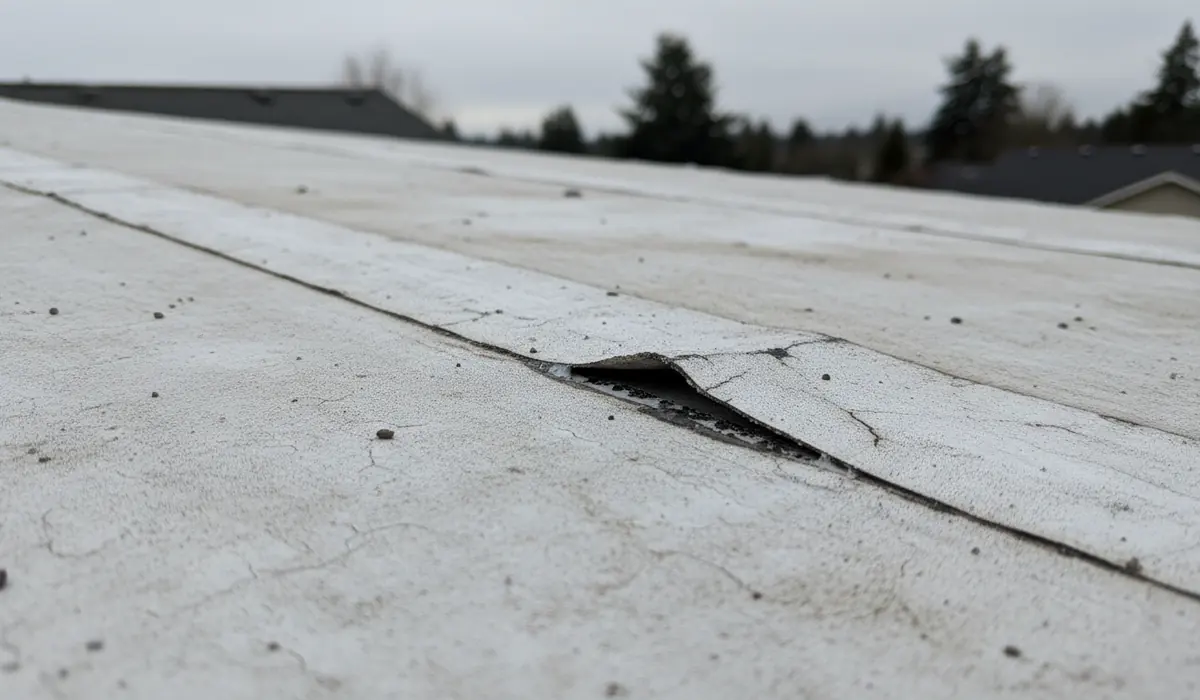
Commercial roof replacement isn’t on a fixed calendar — it’s a range that depends heavily on the system installed and how it’s maintained. Here’s a realistic way to think about the timeline.
What manufacturer warranties actually say
TPO and EPDM single-ply membranes commonly carry manufacturer warranties in the 15-30 year range, depending on membrane thickness and the specific product line. Modified bitumen systems carry similarly ranged warranties depending on the specific product and application method. These numbers describe material defect coverage under specified installation and maintenance conditions — they’re a useful reference point, not a promise that every roof will last exactly that long regardless of what happens to it afterward.
Why realized life in this climate often runs shorter than the warranty term
Tacoma’s marine climate delivers sustained moisture exposure across roughly 153 rainy days a year, along with UV exposure and thermal cycling (temperature swings that expand and contract roofing materials) across the rest of the year. Without a maintenance program catching small issues early, these conditions tend to accelerate wear — seam separations, membrane punctures, and insulation moisture problems that would be minor and cheap to fix become larger failures the longer they go unaddressed. This is a general pattern across the Pacific Northwest’s marine climate, not unique to any one building.
Why a maintenance program pushes realized life toward the higher end
The single biggest factor in whether a commercial roof reaches or exceeds its warranty term is whether someone is regularly checking it. Small membrane punctures, seam issues, and drainage problems are inexpensive to repair when caught early and expensive when they’ve been allowed to let water into the insulation layer. A roof on a planned inspection schedule routinely outperforms an identical roof left alone until something visibly fails.
Signs a commercial roof is approaching real end-of-life
- Widespread membrane wear — brittleness, cracking, or seam failures across multiple areas rather than one isolated spot.
- Recurring leaks in different locations, rather than one contained issue.
- Visible or infrared-detected insulation moisture across a significant portion of the roof — once insulation is wet, drying it out isn’t practical, and that section needs to come out.
- Ponding water that no longer drains within the expected window after rain, indicating the roof’s slope or drainage has degraded.
What this means for budgeting
Rather than budgeting for full replacement on a fixed calendar date, the more accurate approach is budgeting for regular inspections and planned repairs, with replacement scheduled once an inspection shows the roof has genuinely reached the point where repair no longer makes economic sense compared to replacement.
Bottom line
Expect a well-maintained commercial roof in this climate to reach or exceed its warranty term, and a neglected one to fall short of it — maintenance, not just the calendar, is what actually determines replacement timing. Call (253) 201-1336 for an inspection that tells you honestly where your roof stands.
The bottom line
If you want this priced for your own roof rather than in ranges, we come out and inspect at no charge across Tacoma and Pierce County. You get a written per-square price with tear-off and any deck repair broken out separately. Call (253) 201-1336.