Decision Guide
Repair vs. Replace: What Are the Warning Signs You Need a Full Roof Replacement?
The specific signs that mean patching a Tacoma roof is the wrong call, and when a repair genuinely is the right, cost-effective answer instead.
Repair is usually right for isolated, localized damage on a roof within its rated lifespan. Replacement becomes the better call when damage spreads across multiple sections, the roof is near or past its 20-30 year rated life, you're on a repeat repair for the same recurring issue, or the deck itself is damaged — patching over deck problems doesn't fix them.
Published 2026-08-31 · Updated 2026-08-31
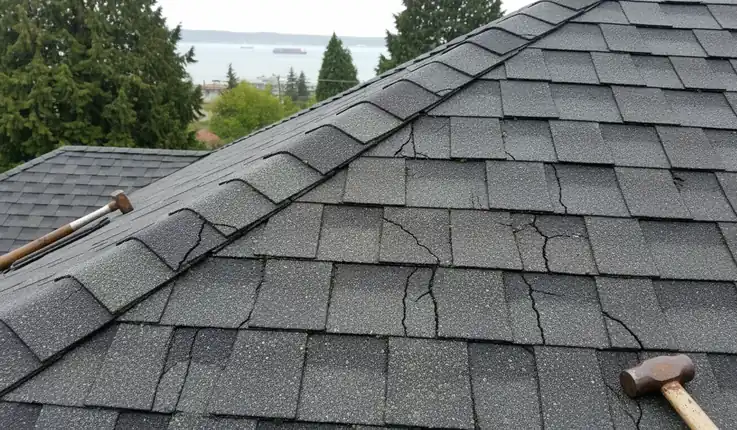
The line between “patch it” and “replace it” isn’t always obvious from a single leak — here’s how to read the actual signs.
Signs that point to repair
- The damage is localized — one section, one leak source, one storm-damaged area, rather than spread across the whole roof.
- The roof is well within its rated lifespan — asphalt shingle is manufacturer-rated 20-30 years, and a roof still in its first half of that range with an isolated issue is usually a repair candidate.
- This is the first time you’ve had this specific problem — a first repair on a roof with no history of recurring issues is generally the right response.
- The cause is identifiable and fixable — a specific failed flashing seal, a storm-torn section, a punctured spot — problems with a clear, contained cause repair well.
Signs that point to replacement
- Damage is spread across multiple sections rather than one localized spot — patching three or four separate areas often costs close to what replacement does, without buying you a fresh roof.
- The roof is near or past its rated life. PNW-wide patterns, driven by moss, rain, and wind exposure, routinely shorten realized roof life below the manufacturer rating — a roof at or past 20-25 years with any new problem is worth evaluating for full replacement rather than another patch.
- You’re on a second or third repair for the same recurring issue — if the same leak or the same area keeps failing after being fixed, the underlying material or installation has likely reached the point where patching doesn’t hold.
- The deck itself is damaged. Rotten or delaminated sheathing found underneath the roofing surface can’t be properly fixed without pulling back the roofing — patching over it doesn’t address the actual problem, and it’s more common on Tacoma’s older pre-1930 housing stock in North Slope and Stadium-Seminary.
- Multiple prior repairs already exist on the roof, each addressing a different area — a pattern of ongoing patchwork is often a sign the roof as a whole has reached the end of its useful service life.
Why deck condition is the real tie-breaker
A repair can only address what’s on top of the deck — shingles, underlayment, flashing. If the deck itself has soft spots, delamination, or rot, no surface repair actually fixes the underlying structural issue, and it will keep causing problems in that area regardless of how many times the visible roofing gets patched. This is exactly why a genuine inspection — not just a look at the leak — matters before deciding.
How we make this call
We don’t default to recommending replacement because it’s the bigger job — a straightforward, well-contained repair on a sound roof is the right recommendation more often than not, and we’ll tell you that directly. What we look at: damage pattern and extent, roof age against its rated life, deck condition where it’s exposed, and whether this is a first issue or a recurring one.
Bottom line
Isolated damage on a roof within its rated life usually means repair. Widespread damage, a roof near end-of-life, recurring failures, or deck damage usually means replacement is the more cost-effective path. Call (253) 201-1336 and we’ll give you an honest read on which one your roof actually needs.
The bottom line
If you want this priced for your own roof rather than in ranges, we come out and inspect at no charge across Tacoma and Pierce County. You get a written per-square price with tear-off and any deck repair broken out separately. Call (253) 201-1336.