
Decision Guide
How Do I Tell If Roof Damage Is Storm-Related or Pre-Existing Wear?
How to distinguish wind/storm-caused roof damage (usually covered by insurance) from gradual wear (usually not), before you file a claim.
Storm damage tends to be localized, sudden, and traceable to a specific event — torn or missing shingles concentrated on the wind-facing side, a puncture from debris, damage appearing right after a documented storm. Pre-existing wear tends to be spread evenly across the roof, tied to age and granule loss rather than one event, present in sections a storm's wind wouldn't have hit hardest.
Published 2026-08-31 · Updated 2026-08-31
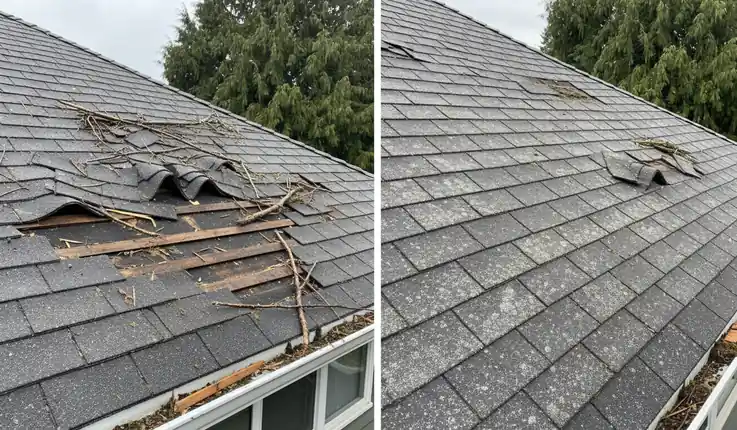
This distinction decides whether an insurance claim has a real chance — and it’s not always obvious just by looking at a leak. Here’s how to actually tell the two apart.
Signs that point to storm damage
- Localized to one side or area — damage concentrated on the side of the roof that faced the storm’s wind direction, rather than spread evenly across every plane.
- Sudden and complete — shingles torn off entirely or visibly displaced, rather than gradually thinning or curling.
- Traceable to a specific event — damage that wasn’t there before a documented storm and appeared right after it.
- Accompanied by other storm evidence — debris in the yard, a fallen limb, neighboring properties with similar damage from the same event.
- Impact marks — dents, punctures, or cracked material consistent with wind-blown debris rather than gradual weathering.
Signs that point to pre-existing wear
- Evenly distributed — thinning, curling, or granule loss spread across the whole roof rather than concentrated on one wind-facing side.
- Gradual, not sudden — shingles that are cupped, cracked, or brittle throughout rather than physically torn or missing.
- Concentrated on the sun-exposed side — wear often shows up hardest on south-facing slopes regardless of wind direction, since UV exposure drives it more than storms do.
- Consistent with the roof’s age — if the roof is at or past its rated 20-30 year lifespan for asphalt shingle, wear becomes the more likely explanation for general deterioration.
- No supporting storm evidence — no debris, no matching damage timeline, nothing that ties the condition to a specific weather event.
Why this distinction determines insurance coverage
Homeowners insurance generally covers sudden, storm-caused damage as a covered peril, but treats gradual wear as a maintenance issue outside coverage — see our guide on wind damage insurance coverage in Washington for the fuller breakdown. An adjuster is specifically looking for the signs above to make that call, which is exactly why documentation and a professional read matter before you file.
What a professional inspection adds
An inspector trained to spot the difference looks at damage pattern relative to wind direction, the condition of unaffected roof areas for comparison, and whether the specific type of damage (tears vs. gradual curling) matches a storm mechanism or an aging mechanism. This is often the deciding factor between a claim that gets approved and one that gets pushed back on.
When it’s genuinely both
An older roof can sustain real new storm damage on top of existing wear — these aren’t mutually exclusive. A good inspection separates what’s new and storm-caused from what was already there, which matters both for an honest claim and for scoping the actual repair correctly.
Bottom line
The pattern, timing, and location of damage — not just its presence — is what separates storm damage from wear. Call (253) 201-1336 for an honest assessment before you decide whether to file a claim.
The bottom line
If you want this priced for your own roof rather than in ranges, we come out and inspect at no charge across Tacoma and Pierce County. You get a written per-square price with tear-off and any deck repair broken out separately. Call (253) 201-1336.